
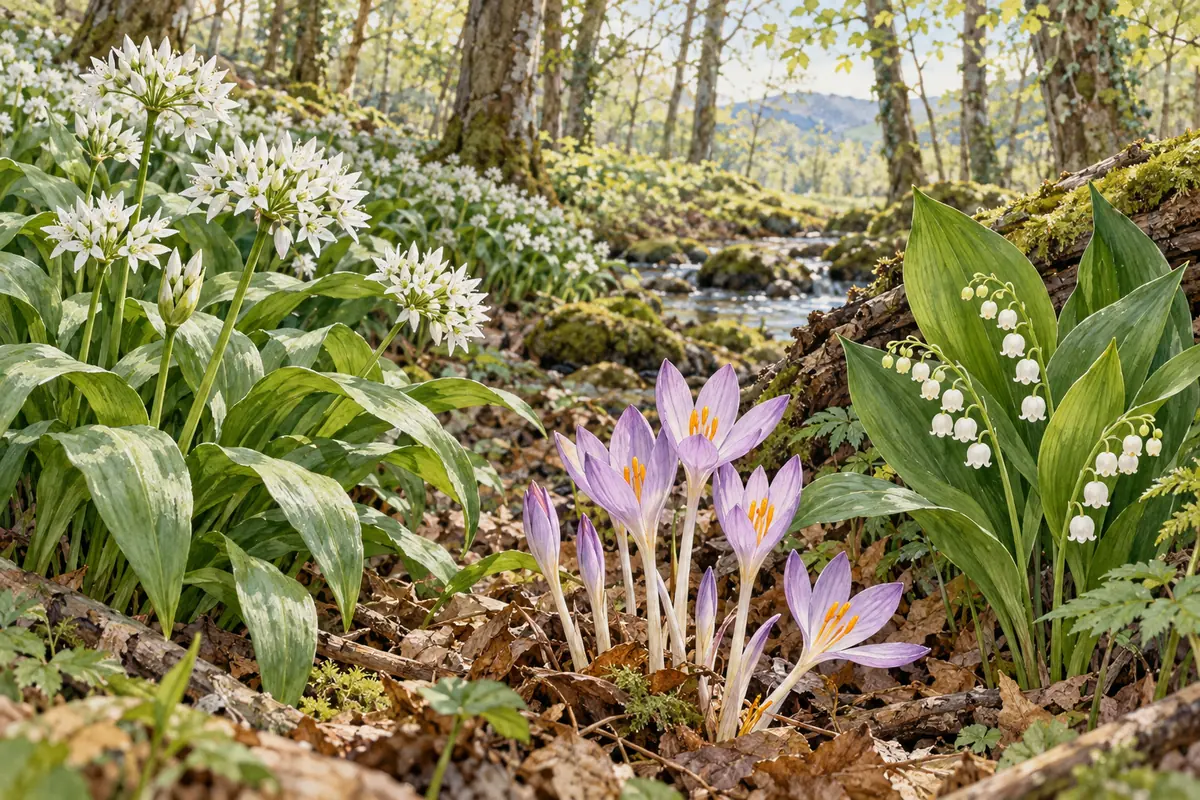
Wild garlic, autumn crocus and lily of the valley
Wild garlic (Allium ursinum) is edible; autumn crocus (Colchicum autumnale) and lily of the valley (Convallaria majalis) are poisonous. Autumn crocus can cause fatal poisoning. All three may grow in spring woodland understorey. [1] [14]
Wild garlic (Allium ursinum) often grows in damp woodland and may share spring understorey habitats with toxic species. Reports collected by ANSES document confusions with autumn crocus (Colchicum autumnale) and lily of the valley (Convallaria majalis), particularly when leaves are seen without flowers. [1] [2]
Wild garlic leaves are generally single, lance-shaped and stalked. Lily-of-the-valley leaves often occur in pairs and sheath the flowering stem, while autumn crocus may produce several leaves close together. A garlic smell is described when a wild-garlic leaf is rubbed, but smell or shape alone is not a reliable identification method: toxicovigilance reports document real mix-ups. [1] [3]
Season makes the contrast clearer. Wild garlic forms carpets of oval, long-stalked leaves in cool woodland and bears white star-shaped flowers in spring umbels. Autumn crocus produces narrow leaves in spring but opens its purple flowers in autumn, often after the leaves have disappeared. Lily of the valley usually carries two parallel-veined leaves and, later in spring, an arching row of white bells; red berries follow in summer. [1] [14]
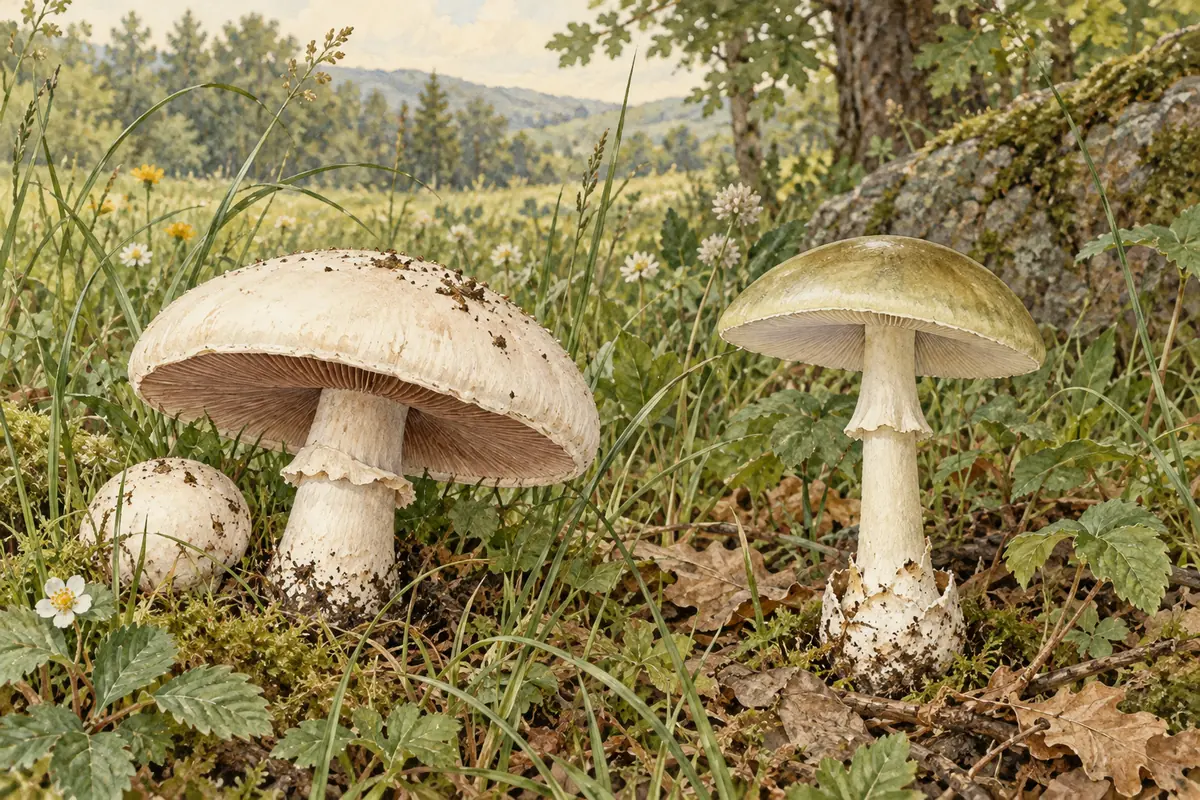
Field mushroom and death cap
The field mushroom (Agaricus campestris) is edible and grows in meadows and lawns. The death cap (Amanita phalloides) is poisonous and can be fatal. Young specimens of both may look pale, but belong to different genera. [4] [11]
The field mushroom (Agaricus campestris) and death cap (Amanita phalloides) may both look pale when young, but belong to different genera and change as they develop. Death-cap gills remain pale; Agaricus gills turn pink and then dark brown as spores mature. A volva may be present at the base of a death cap, while the field mushroom has no volva. [4]
A ring may be present on a death cap and can be inconspicuous at some stages; it may also deteriorate or remain covered by soil. In an early stage, the veil enclosing the mushroom can hide features. A cap photograph, apparent colour or single detail therefore does not describe the whole specimen. [4]
Habitat adds context: field mushrooms are characteristic of meadows and lawns, while death caps associate with tree roots and occur in woodland settings. Field-mushroom gills change from pink to dark brown as spores mature; death-cap gills remain white. The volva is the cup-like remnant of the universal veil around the death cap’s base, complementing the ring on its stem. [4] [11]
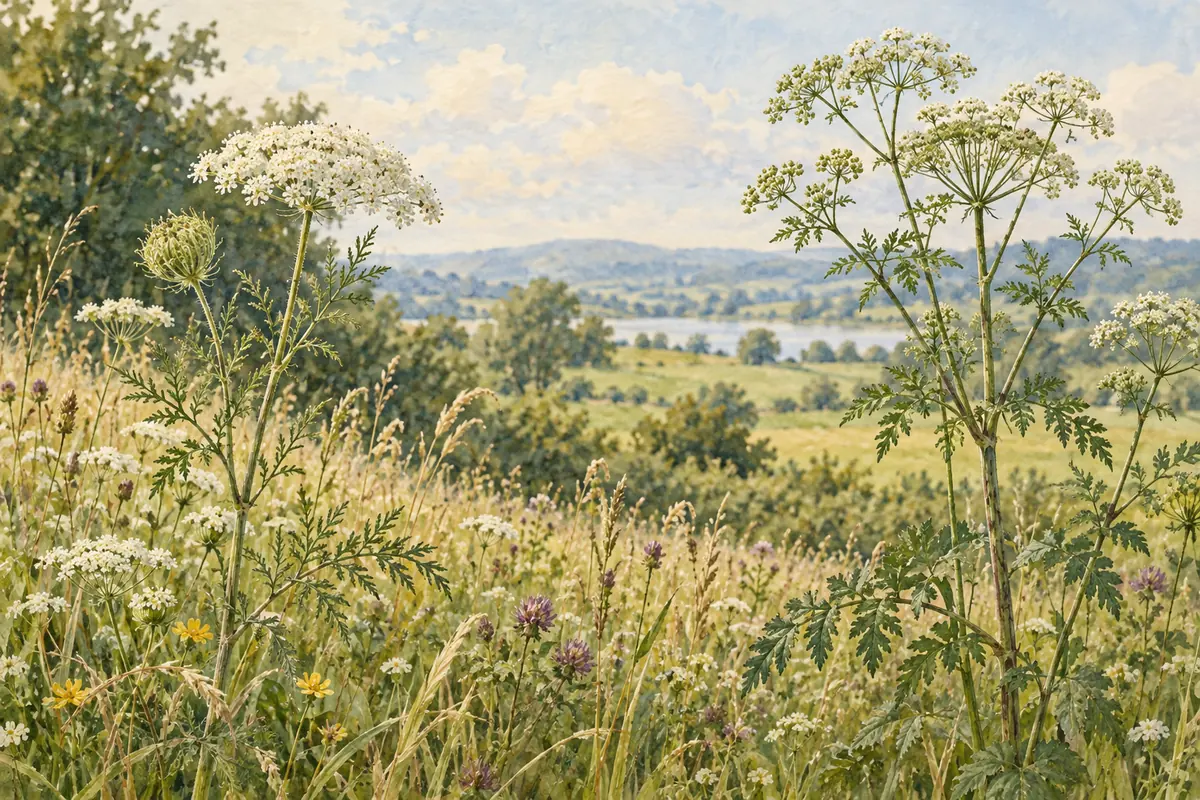
Wild carrot and poison hemlock
The root of wild carrot (Daucus carota) is edible. Poison hemlock (Conium maculatum) is highly toxic in every part. Umbels of small flowers and divided leaves explain their broad resemblance. [2] [5]
Wild carrot (Daucus carota) and poison hemlock (Conium maculatum) are both members of the Apiaceae and produce compound umbels made up of many small flowers. Finely divided leaves and upright stems add to their broad resemblance. Poison hemlock is a toxic species documented in confusions with plants used as food. [2] [5]
Poison hemlock often has smooth, hollow stems with purple blotches; wild carrot stems tend to be hairy. These are descriptive features useful in a botanical comparison, but their visibility can vary with a specimen’s age and condition. Many Apiaceae also resemble one another: the absence of a blotch or presence of hairs does not establish identity by itself. [5]
Wild carrot is biennial: in its first year it forms a low rosette and thickened root; in its second it sends up a flowering stem with white umbels, sometimes with a small dark central floret. Poison hemlock also begins as a rosette before producing a tall, branched, smooth, hollow and purple-spotted stem. Their shared Apiaceae family explains the similar flower-head structure; leaf and stem features add further distinctions. [2] [5]
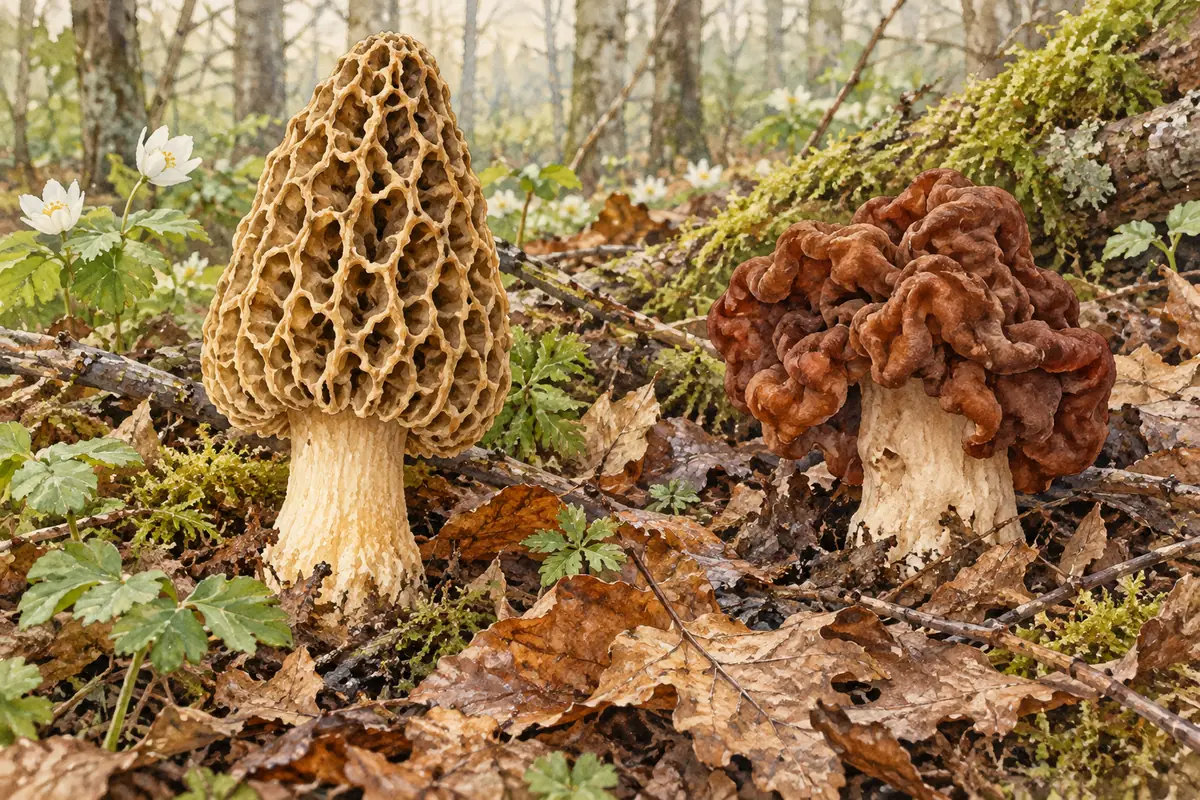
Morel and Gyromitra
True morels in the genus Morchella, including Morchella esculenta, are edible only when thoroughly cooked; they are not eaten raw. Gyromitra esculenta is toxic because it contains gyromitrin. [9] [10] [12]
True morels belong to the genus Morchella. Their caps have pits and ridges; mature morels are described as hollow inside. Several fungi colloquially called “false morels” belong to other genera, including Gyromitra, whose caps may be folded or lobed. [8]
Gyromitra esculenta contains gyromitrin, which can be converted in the body to monomethylhydrazine; medical literature describes gastrointestinal, liver and neurological effects. The common name “false morel” covers different fungi, so it is neither one species nor a uniform group. [9]
A true morel’s cap is a honeycomb network of pits and ridges and continues directly into the stem; both cap and stem are hollow. Gyromitra instead has irregular lobes and folds that create a brain-like outline. These are distinct groups of ascomycete fungi often paired in common names: gyromitrin makes Gyromitra esculenta toxic, while Morchella esculenta is described as edible after thorough cooking. [8] [9] [10] [12]
Bilberry and belladonna
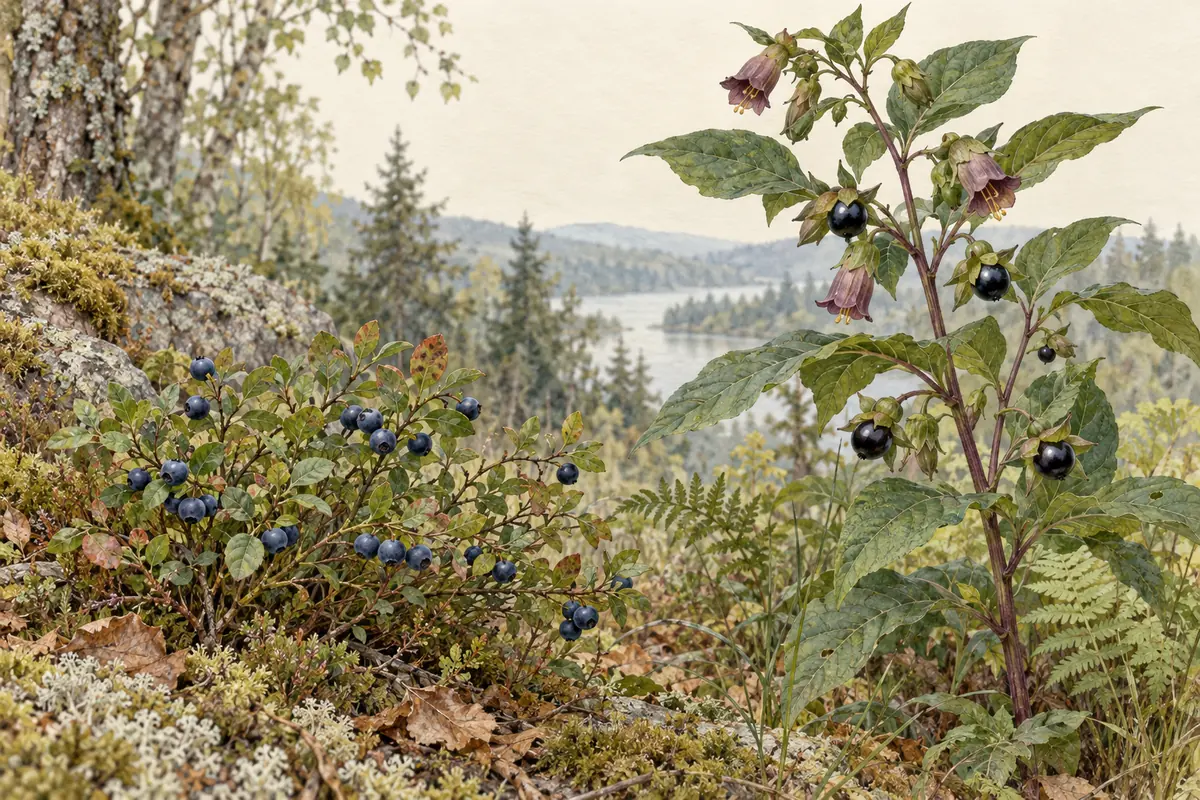
Bilberry (Vaccinium myrtillus) berries are edible and used as food. Belladonna (Atropa belladonna) is poisonous; its dark berries contain toxic alkaloids. Bilberry is a low shrub, while belladonna is a taller plant. [6] [13]
Bilberry (Vaccinium myrtillus) is a low shrub with green, angled stems, toothed leaves and dark blue berries often covered by a pale bloom. Belladonna (Atropa belladonna) is a taller herbaceous plant; its ripe fruits are dark, glossy berries. The contrast between a low shrub and an upright plant provides context, but an individual fruit can be misleading. [6] [7]
Belladonna contains tropane alkaloids, and its berries have been involved in poisoning cases after being mistaken for blueberries. Botanical descriptions of bilberry, by contrast, report a low plant with finely toothed deciduous leaves and blue-black berries. [6] [7]
Vaccinium myrtillus remains a low shrub with green, angled stems, toothed leaves and dark blue berries covered by a pale bloom; its fruit is used as food. Atropa belladonna grows taller, with broad leaves, hanging brown-purple flowers and glossy black berries borne singly in the leaf axils. Its parts, including the berries, contain tropane alkaloids. Growth form, flowers and fruit arrangement complete the comparison. [6] [7] [13]
Sources and further reading
- ANSES — Confusions alimentaires entre colchique et ail des ours ou poireau sauvage (rapport de toxicovigilance, 2023)
- ANSES — Vigil’Anses, numéro 8 : confusions entre plantes sauvages et plantes toxiques (2019)
- German Federal Institute for Risk Assessment (BfR) — Wild garlic: confusion often leads to poisoning
- Australian National Botanic Gardens — Death cap mushroom (Amanita phalloides)
- University of Minnesota Extension — Poison hemlock
- German Federal Institute for Risk Assessment (BfR) — Black belladonna
- USDA Forest Service — Whortleberry (Vaccinium myrtillus)
- Michigan Department of Natural Resources — Morel mushroom identification
- StatPearls / NCBI Bookshelf — Gyromitra Mushroom Toxicity (updated 2024)
- White et al. — Warning on False or True Morels and Button Mushrooms with Potential Toxicity Linked to Hydrazinic Toxins: An Update, Toxins (2020)
- Missouri Department of Conservation — Meadow Mushroom (Agaricus campestris), edibility and morphology
- Oregon State University, Andrews Forest — Morchella esculenta: edible morel, never raw
- U.S. National Institutes of Health — Bilberry (Vaccinium myrtillus), fruit use
- German Federal Institute for Risk Assessment — Poisonous plants FAQ (2025), wild garlic and toxic lookalikes