
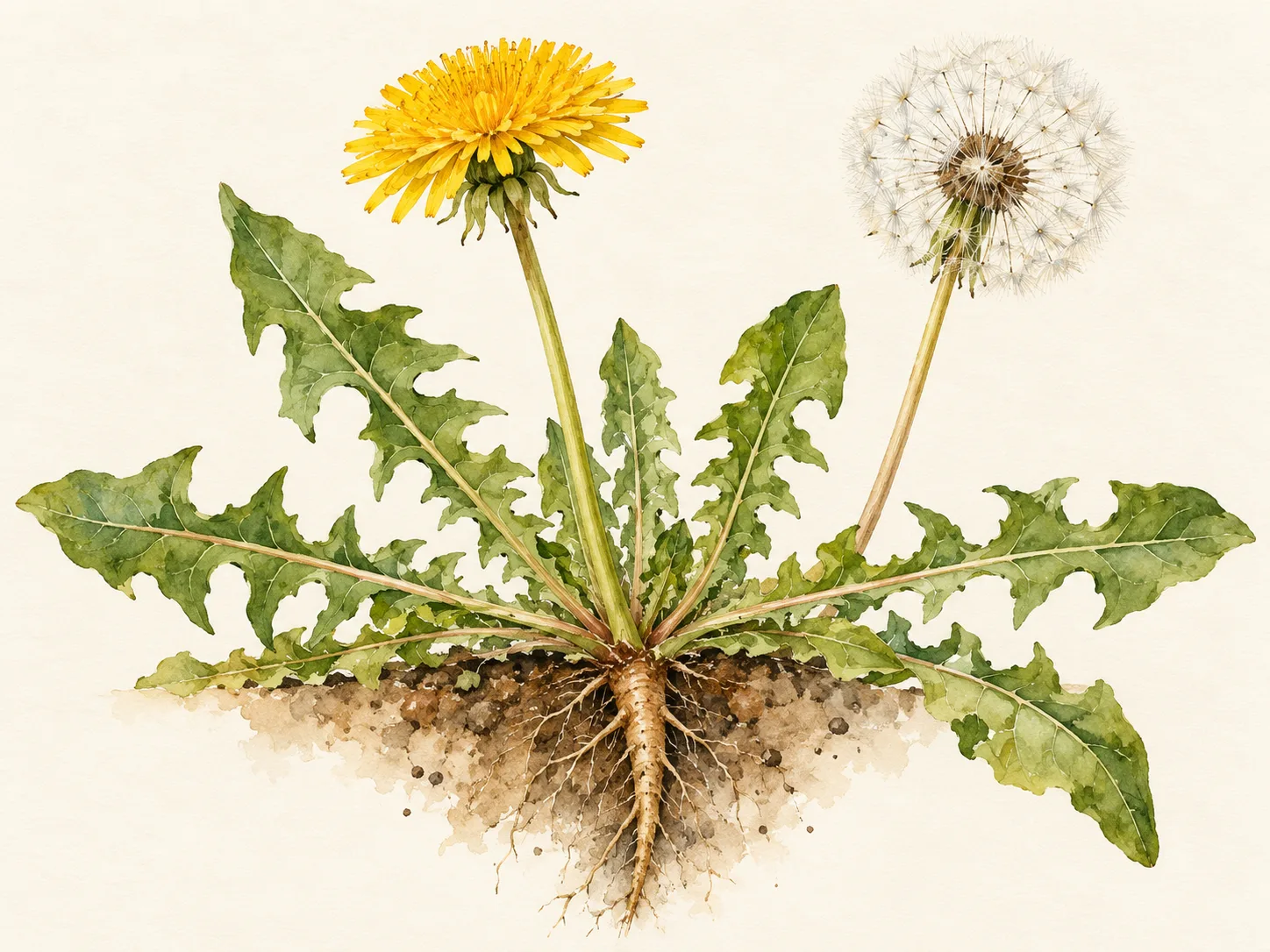
Dandelion and blowball are common names for plants in the genus Taraxacum, in the Asteraceae family. This article focuses on the common dandelion, often listed as Taraxacum officinale aggregate (“agg.”): closely related forms treated together when species classification is complex. The University of Udine flora describes it as a perennial herb; this is a regional botanical reference, while other cited sources document uses and observations in different geographic contexts. [9] [10]
Botany, flowering and life cycle
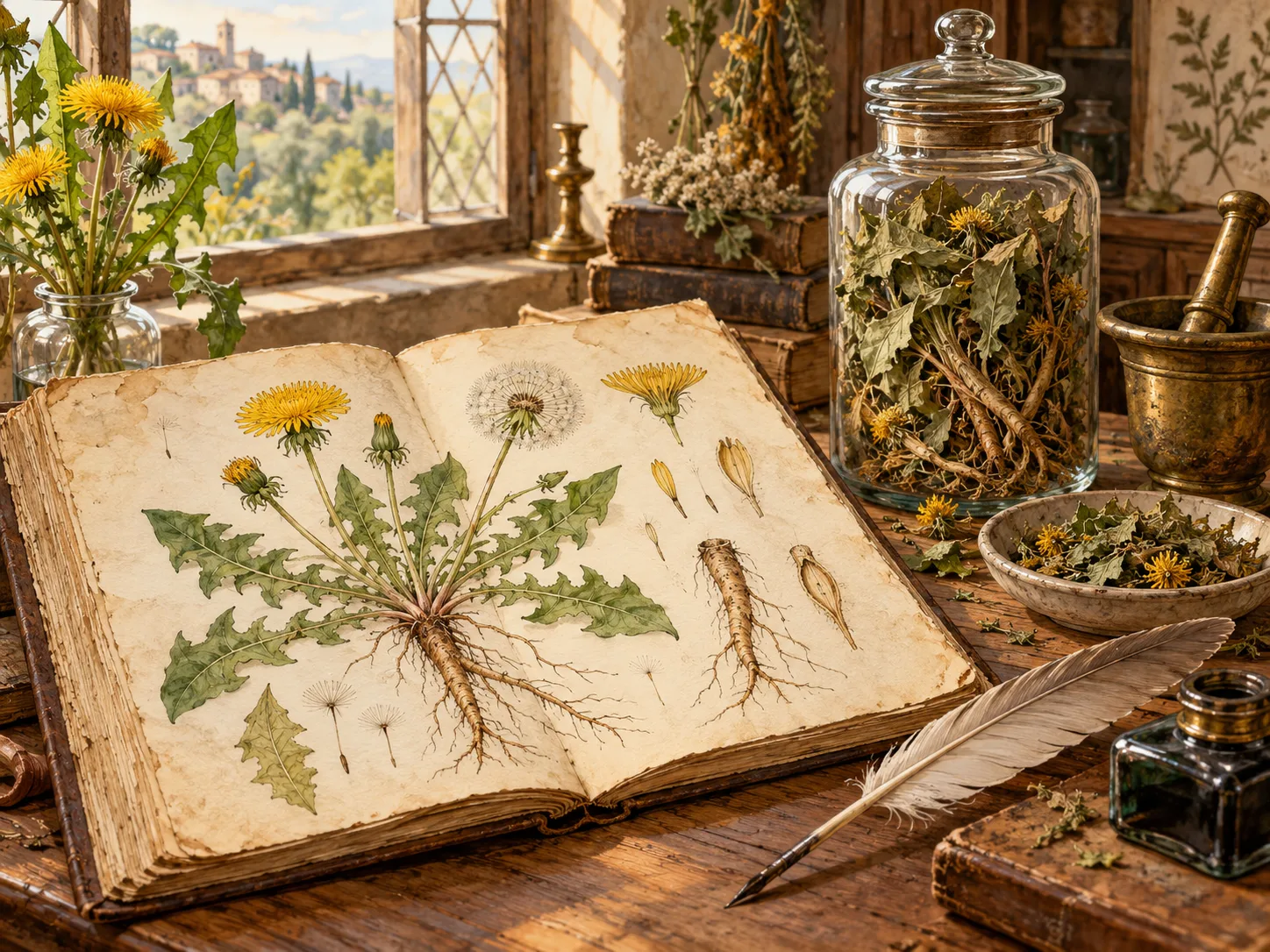
The elongated leaves form a low rosette, with runcinate margins whose side lobes point toward the base. The main root is a taproot. A hollow, leafless flowering stalk, the scape, rises from the rosette and contains white latex. Its flower head has many small yellow flowers. The FAO compendium reports 100–300 per head. Some Taraxacum groups produce seeds without fertilization, a process called apomixis. [4] [9] [11]
After flowering, each achene bears a pappus of bristles that helps wind dispersal; together they form the seed head. The University of Udine flora gives February–May in Friuli-Venezia Giulia; the Royal Horticultural Society gives April–June for the United Kingdom. These examples show how timing varies by region and season. The plant may flower repeatedly and regrow from the root crown. [7] [9]
Hypochaeris radicata, or cat’s-ear, also forms a basal rosette; the RHS describes its leaves as often hairy and its flowering stems as branched. For dandelion, the same source describes hollow, unbranched scapes, each with one flower head. The profiles show some differences among yellow-flowered Asteraceae. [7] [8]
Nutritional profile of the leaves
The table gives values per 100 g for USDA FoodData Central’s “Dandelion greens, raw,” record FDC 169226 and NDB 11207. It is a reference for raw leaves. [3]
| Nutrient | Amount |
|---|---|
| Energy | 45 kcal |
| Protein | 2.7 g |
| Total fat | 0.7 g |
| Carbohydrates | 9.2 g |
| Dietary fibre | 3.5 g |
| Water | 85.6 g |
| Total sugars | 0.71 g |
| Vitamin A | 508 µg RAE |
| Vitamin C | 35 mg |
| Vitamin E | 3.44 mg |
| Vitamin K | 778 µg |
| Calcium | 187 mg |
| Iron | 3.1 mg |
| Phosphorus | 66 mg |
| Magnesium | 36 mg |
| Potassium | 397 mg |
| Sodium | 76 mg |
| Folate | 27 µg |
Per 100 g, water (85.6 g) and carbohydrates (9.2 g) are most abundant; 3.5 g are fibre, and energy is 45 kcal. The entry also records vitamins A, C, E and K and minerals such as calcium, iron, magnesium and potassium. Values and units remain separate to show the complete profile. [3]
“µg RAE” means micrograms of retinol activity equivalents, a common scale for vitamin A activity, including activity associated with plant carotenoids. These data refer to this USDA entry and raw leaves; they do not describe roots, flowers, infusions, extracts or a differently composed serving. [3]
Food uses of leaves, flowers, buds and roots
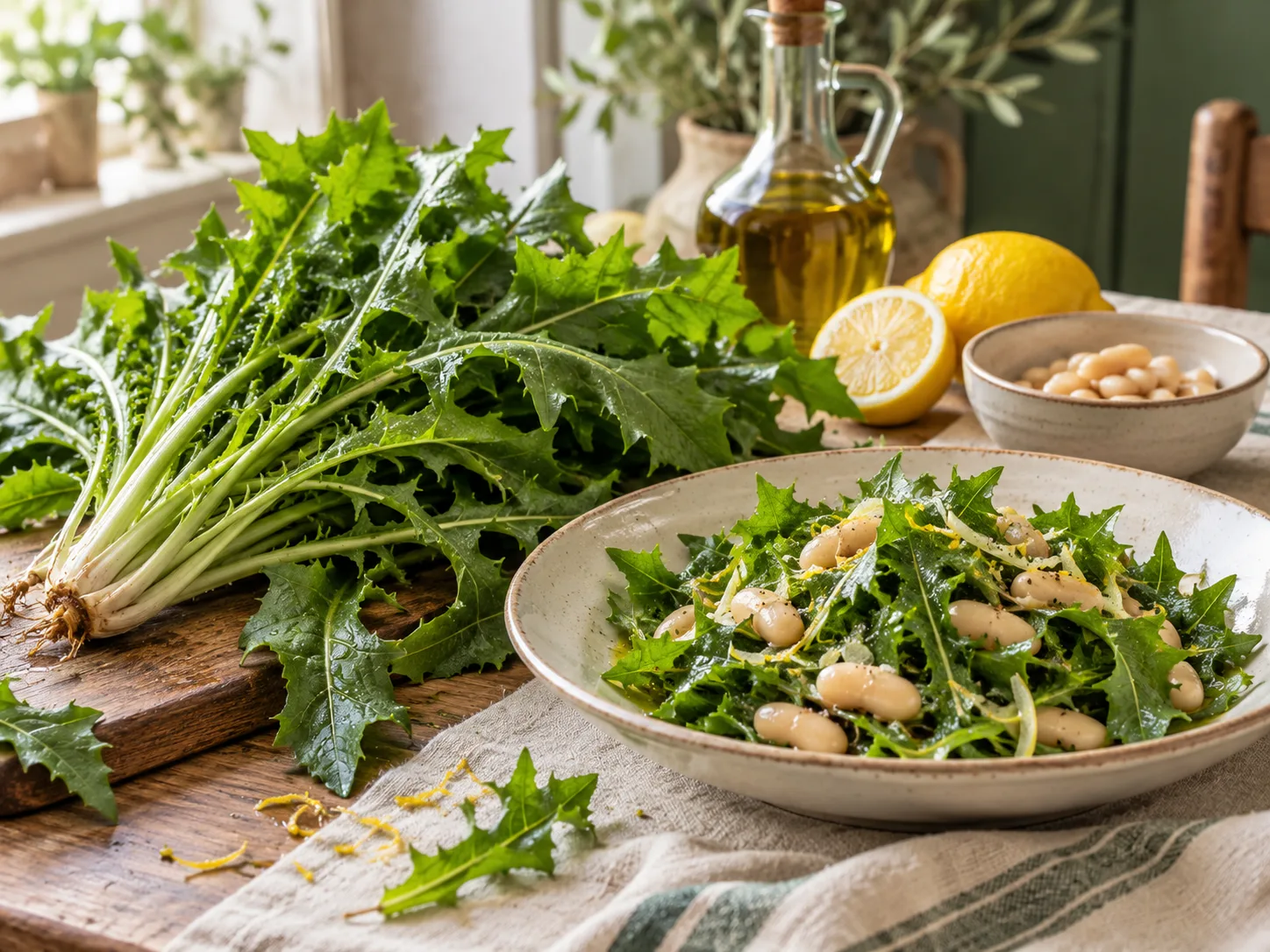
The leaves taste bitter, often more so as the plant matures. Young rosettes are described as suitable raw; older leaves are often cooked. The University of Udine profile documents both as a regional example. Raw leaves appear in salads; cooked leaves in soups, omelettes and sides. Other recipes pair them with potatoes or wild greens. [9] [10] [12]
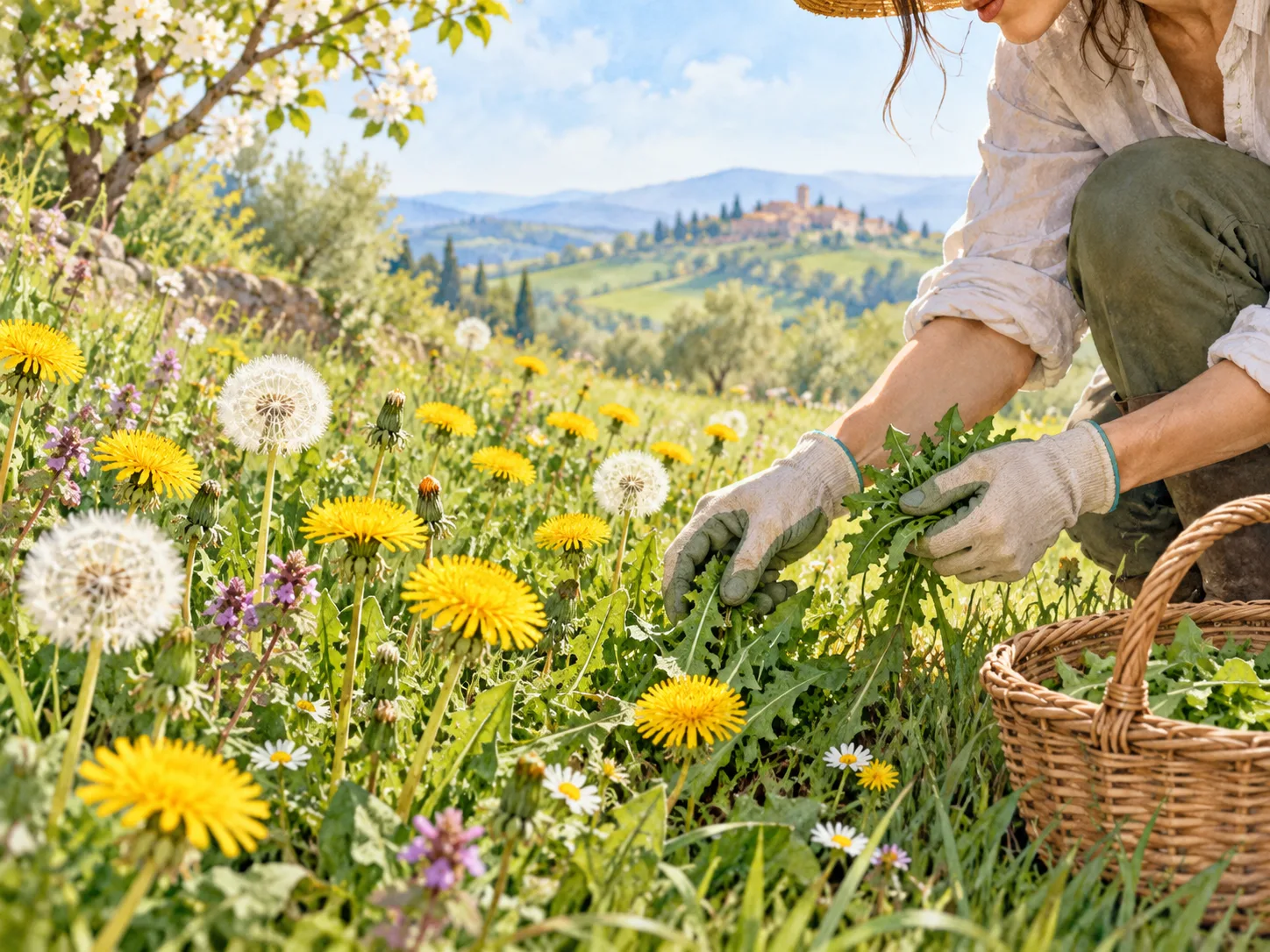
Closed buds are pickled whole and sometimes called “dandelion capers.” A local recipe documented by the Partschins tourism association in South Tyrol briefly cooks and preserves them in water, vinegar and salt. It is a regional example, prepared before the bud opens. [6]
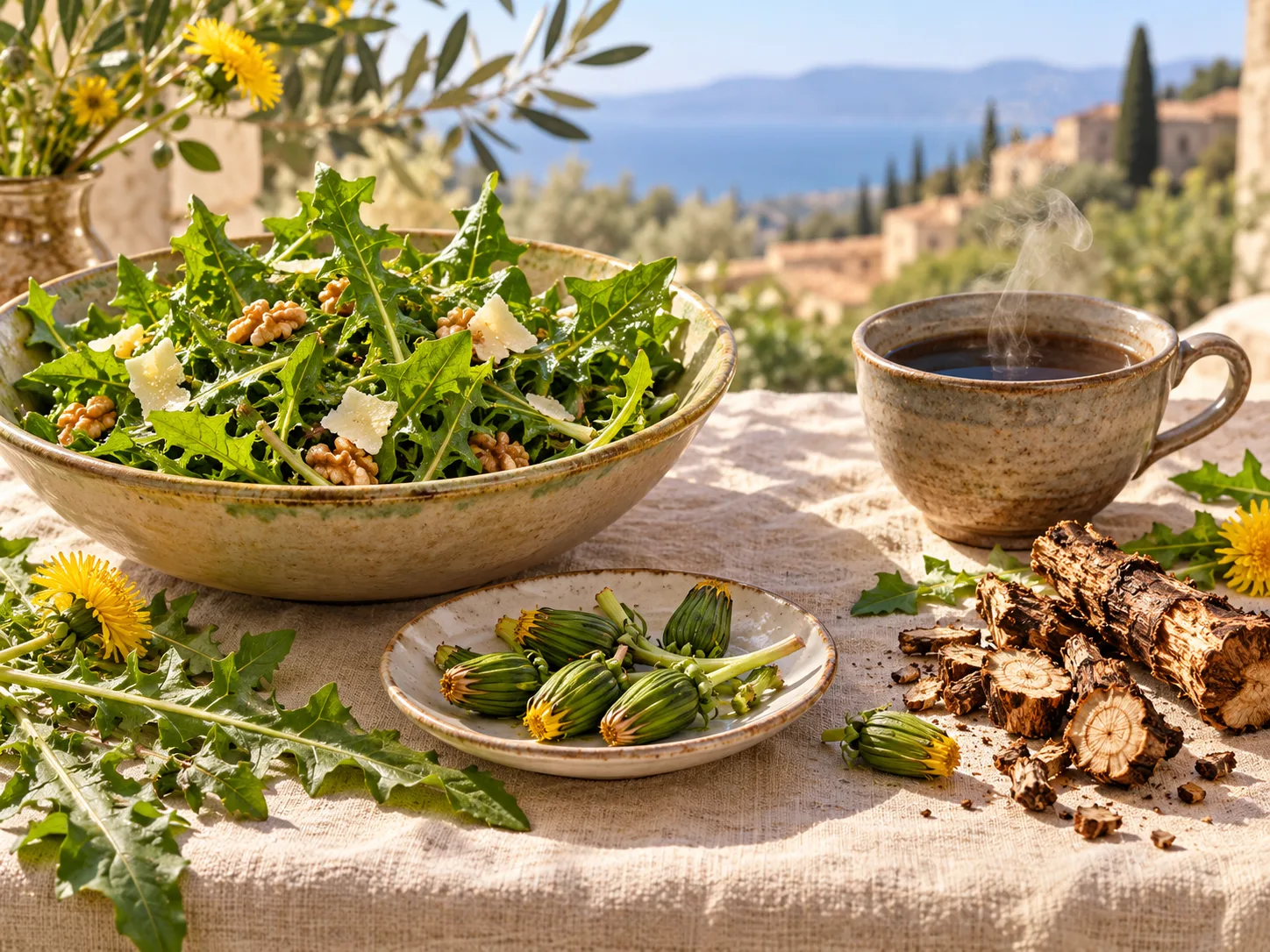
Flowers are used in jellies, syrups and drinks; petals or flower heads may be infused, cooked with sugar or fermented. Sources also describe flower-based beer and wine. Roots can be dried, roasted and ground into a coffee substitute. These methods use different plant parts. [4] [5] [12]
Historical uses and herbal traditions
The EMA report documents dandelion in German folk medicine from the 16th century. A review of Central and Eastern Europe examines sources from the late 18th to the 20th century and records uses of latex, roots, leaves and flower heads. Sources mention infusions, decoctions, tinctures, syrups, poultices and drinks in different contexts and communities. [1] [5]
The EMA monograph examines medicines made from root and aerial parts, including dried material for tea, extracts and expressed juice with defined use. This differs from culinary use. It classifies them as traditional-use medicines and lists traditional indications related to temporary loss of appetite, mild digestive complaints and increased urine output alongside minor urinary complaints. The European category requires at least 30 years’ documented use, 15 within the EU; it is not proof from controlled clinical trials. [1] [2]
Sources and further reading
- EMA — Assessment report on Taraxacum officinale, root and aerial parts
- EMA — European herbal monograph on Taraxacum officinale
- USDA FoodData Central — Dandelion greens, raw (FDC 169226; NDB 11207)
- FAO — Compendium of Forgotten Foods in Africa, “Dandelion,” p. 43
- Multilateral Use of Dandelion in Folk Medicine of Central-Eastern Europe — Plants (2025)
- Tourismusverein Partschins — Pickled dandelion capers
- Royal Horticultural Society — Taraxacum officinale agg.: botanical profile
- Royal Horticultural Society — Hypochaeris radicata: botanical profile
- University of Udine — Floristic catalogue: Taraxacum officinale aggregate
- CNR — Mondo vegetale del Lazio e non solo: Dandelion
- Flora of Rome — Taraxacum sect. Taraxacum
- University of Illinois Extension — From wish to weed: dandelion uses