
Three familiar species, not one ‘easy mushroom’
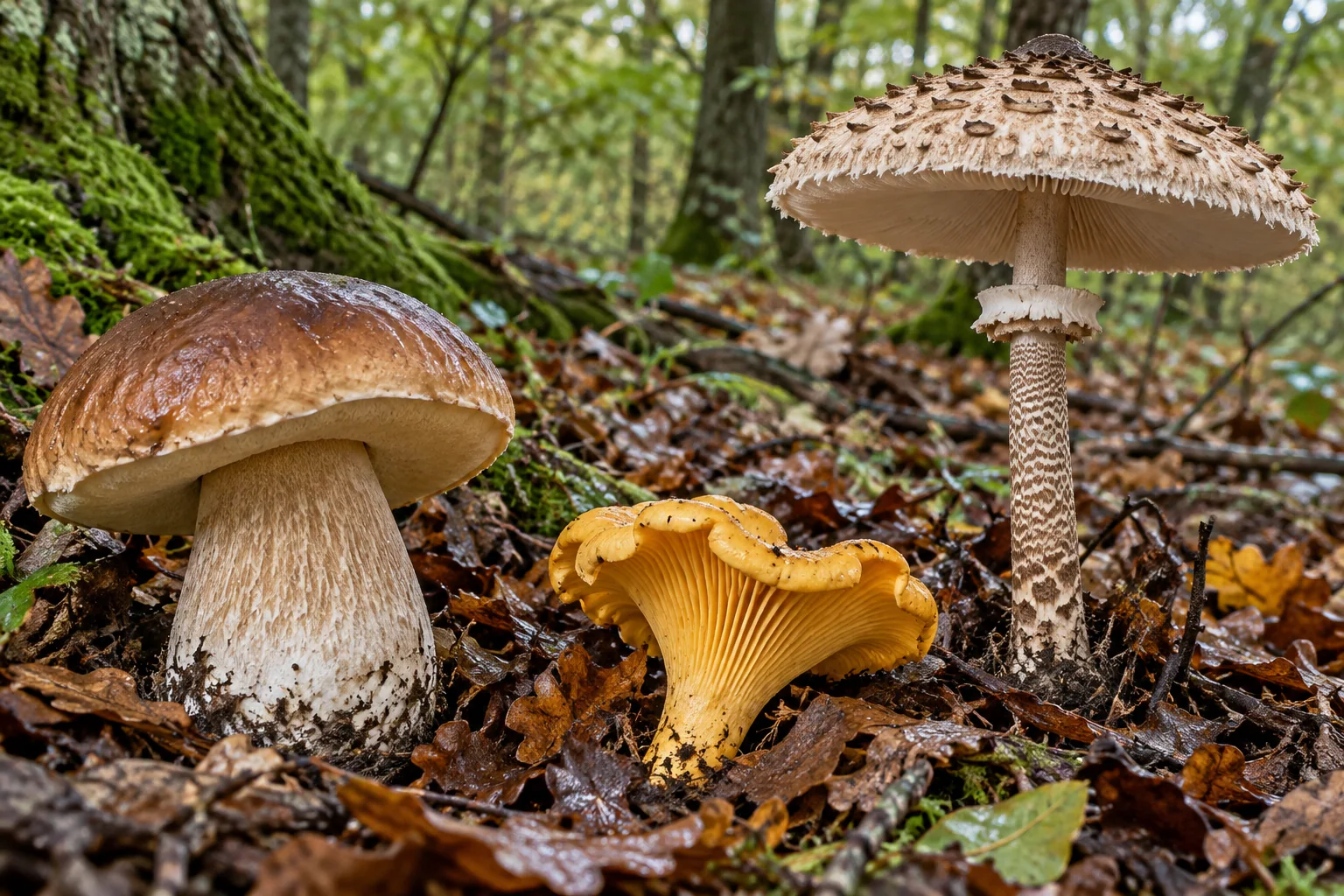
Porcini, chanterelles and parasols are among the best-known wild fungi and are valued in food traditions across Europe. Their popularity reflects conspicuous features, distinct flavours and relatively legible habitats: porcini have a sponge-like underside; chanterelles bear thick branching ridges; parasols can grow large and open into an umbrella shape. [1] [5] [8]
Overall resemblance alone cannot establish a species. Age changes shape and colour, rain affects the surface, and lookalikes may share habitats and fruiting periods. Each profile here combines several observable traits and names documented lookalikes, including poisonous species. The focus is temperate Europe; common names, distribution and local species differ across regions. [2] [4] [6]
The mushroom we see is the fruiting body, a temporary structure that produces spores. Much of the fungus lives in soil or another substrate. Porcini and chanterelles form ectomycorrhizal associations with tree roots; the parasol is saprotrophic and obtains nutrients from decomposing organic matter. [5] [13] [14]
Porcini — Boletus edulis
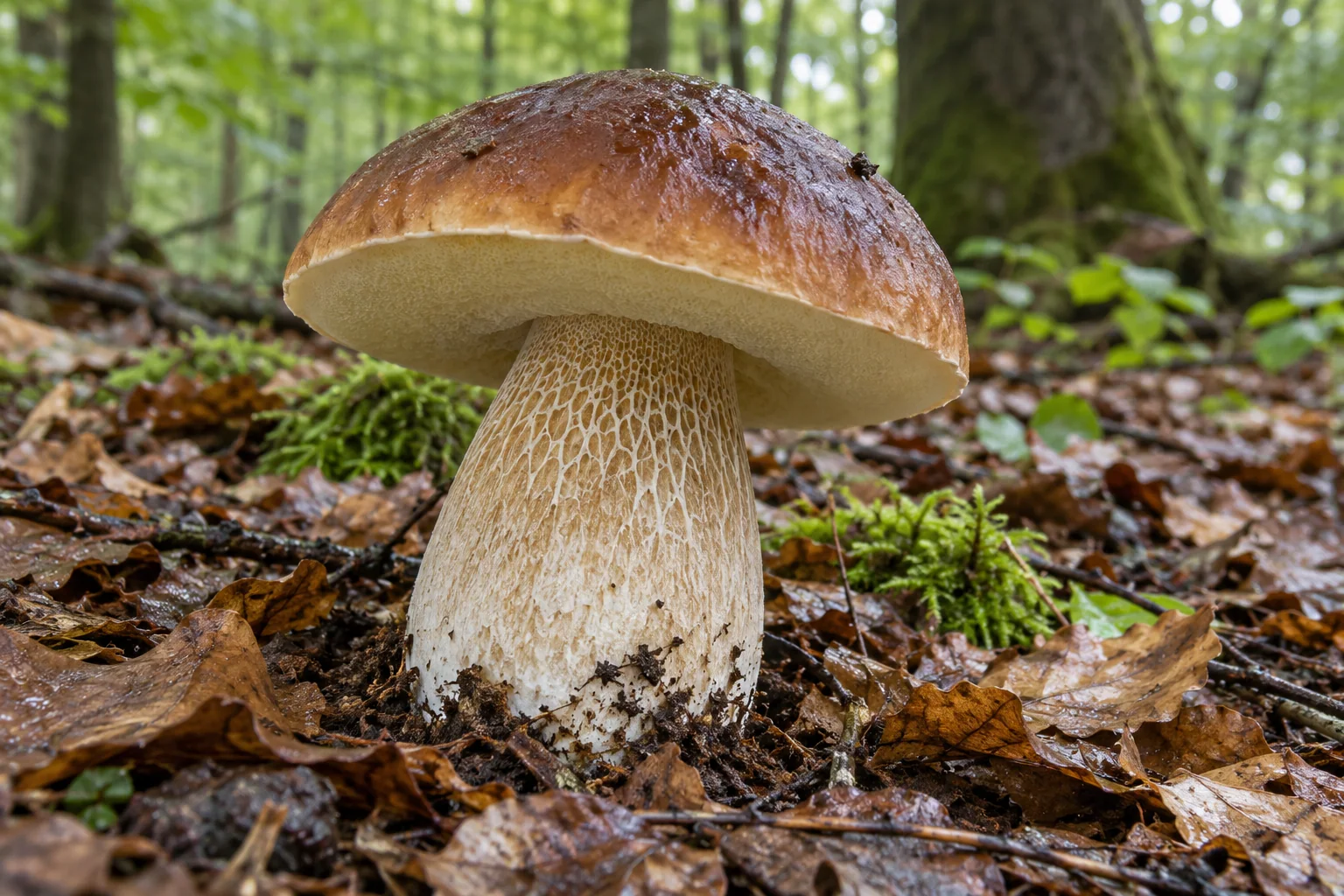
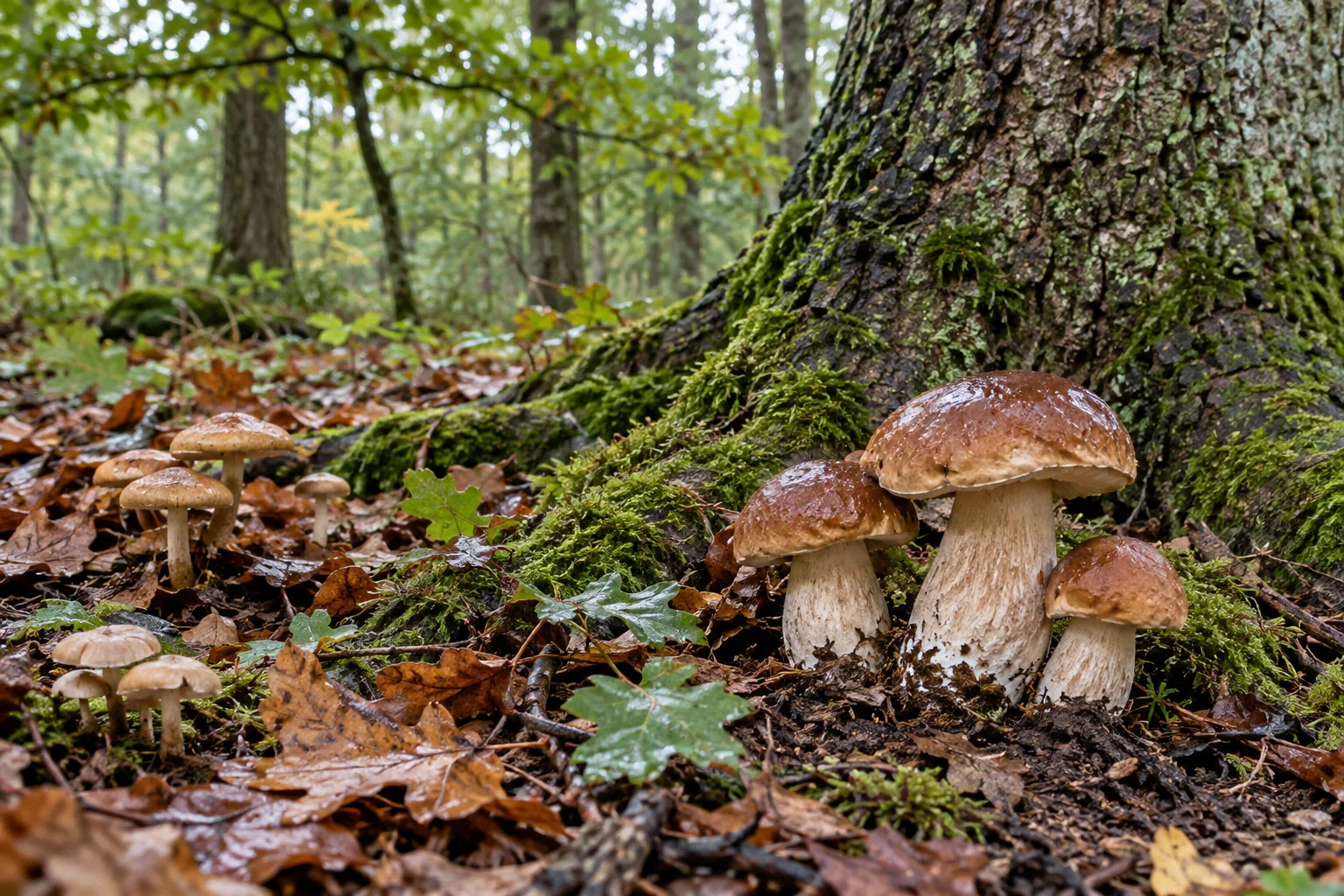
Porcini belongs to the order Boletales. Its cap is fleshy, convex when young and broader with age, in shades from hazelnut to brown. The underside has no gills: tubes end in pores, pale at first and yellow to olive-green as they mature. The stem is stout, often broader at the base, with fine pale reticulation especially near the top; the flesh is white and normally does not turn blue when cut. Size and colour vary with age and conditions. [1] [2]
Boletus edulis grows from the ground in association with host trees, both broadleaved and coniferous. In Europe it often fruits from summer into autumn, though rain, temperature, elevation and local tree species shift the season. It is not routinely farmed like the cultivated button mushroom: availability depends on natural fruiting and woodland conditions. [2] [14]
It is edible and highly valued, used fresh, dried or preserved. Drying concentrates its aroma; rehydrated pieces are used in sauces, soups and risotto. Cap and stem have different textures and can be prepared separately. Nutrition research measures fresh and cooked samples, but gives no universal value: composition and minerals depend on sample, site and processing. [2] [11] [13]
One poisonous lookalike is Rubroboletus satanas, which can cause nausea, vomiting and diarrhoea. It may have a pale, sturdy cap like a porcini, but its pores change rapidly from yellow to red, its stem has red tones, and the flesh may turn faintly blue. These traits describe that species; they are not a universal rule for judging every bolete. Tylopilus felleus is considered inedible because of its intensely bitter taste; its pores tend towards pink and a single specimen can spoil a dish. [3] [4] [15]
Chanterelle — Cantharellus cibarius
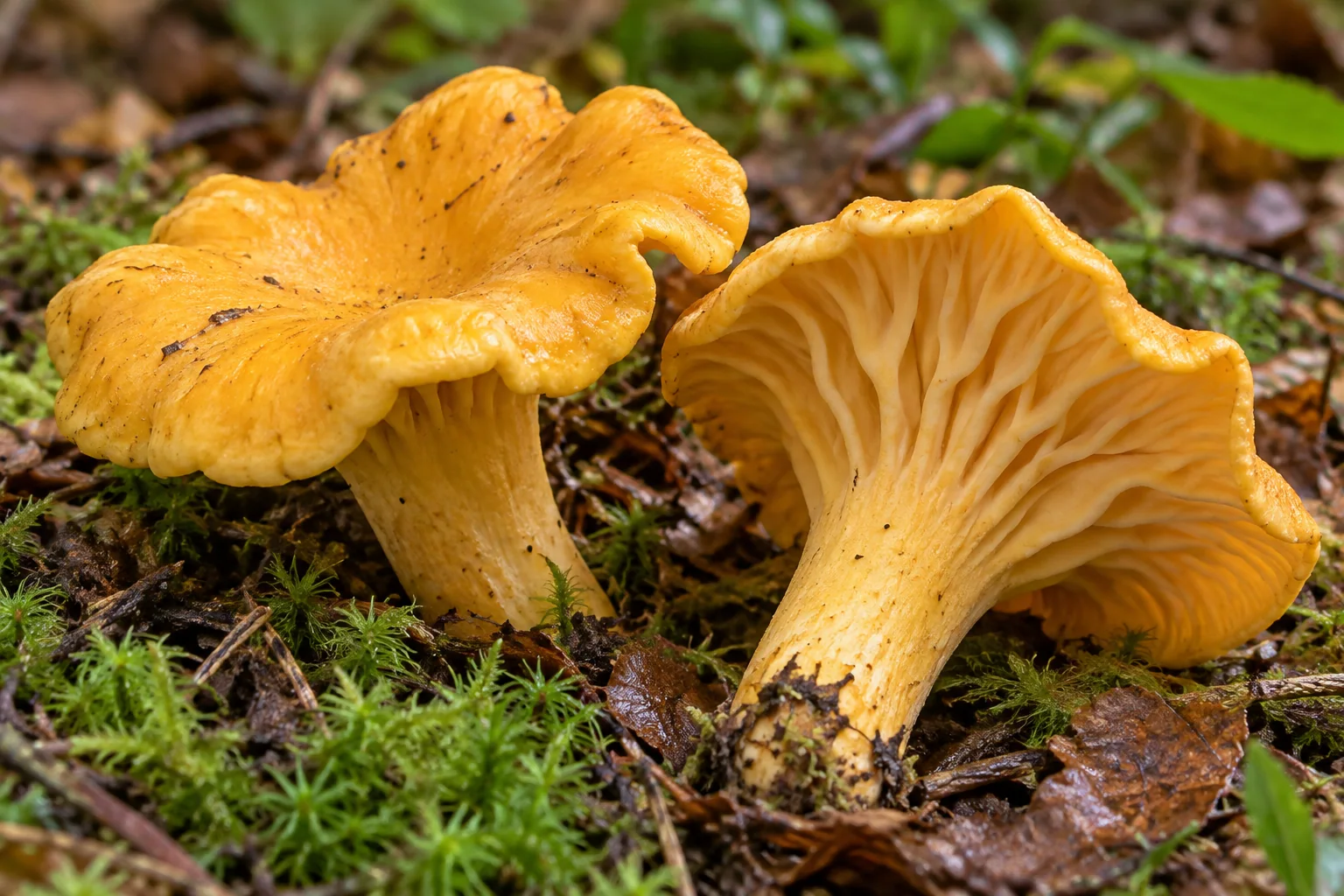
The golden chanterelle has a yellow cap that becomes wavy and funnel-shaped. Its underside bears thick, rounded and often forked ridges that continue down the stem; these are not thin, separate gills. The solid stem narrows towards the base, and the mushroom grows from soil, often scattered through moss and leaf litter. In Europe it commonly fruits from late summer into autumn, with local variation. [5] [6]
Molecular work has revised the group’s taxonomy. Cantharellus cibarius was historically applied to many yellow forms, while studies now distinguish several European species and populations on other continents. Regional guides may therefore use different names, and a common name does not always refer to the same biological entity in every country. [4] [5]
Cantharellus cibarius is edible and sought after for its firm texture and delicate, often fruity aroma. It is cooked in a pan, with eggs, pasta, rice and sauces, and can also be dried, which changes its texture and aroma. Nutrient studies report values that vary by site, preparation and fresh or dry weight; one analysis should not become a fixed figure for every chanterelle. [6] [12]
The best-known poisonous European lookalike is Omphalotus olearius, or related Omphalotus species; they can cause gastrointestinal symptoms such as vomiting and diarrhoea. It often forms clusters on wood or near roots and stumps, with true, thin, crowded gills running down the stem. Chanterelles grow from soil and have thick branching ridges. Hygrophoropsis aurantiaca, the false chanterelle, also has thin gills; sources vary in how they describe its edibility, and it should not be conflated with the documented toxicity of Omphalotus. [6] [7]
Parasol — Macrolepiota procera
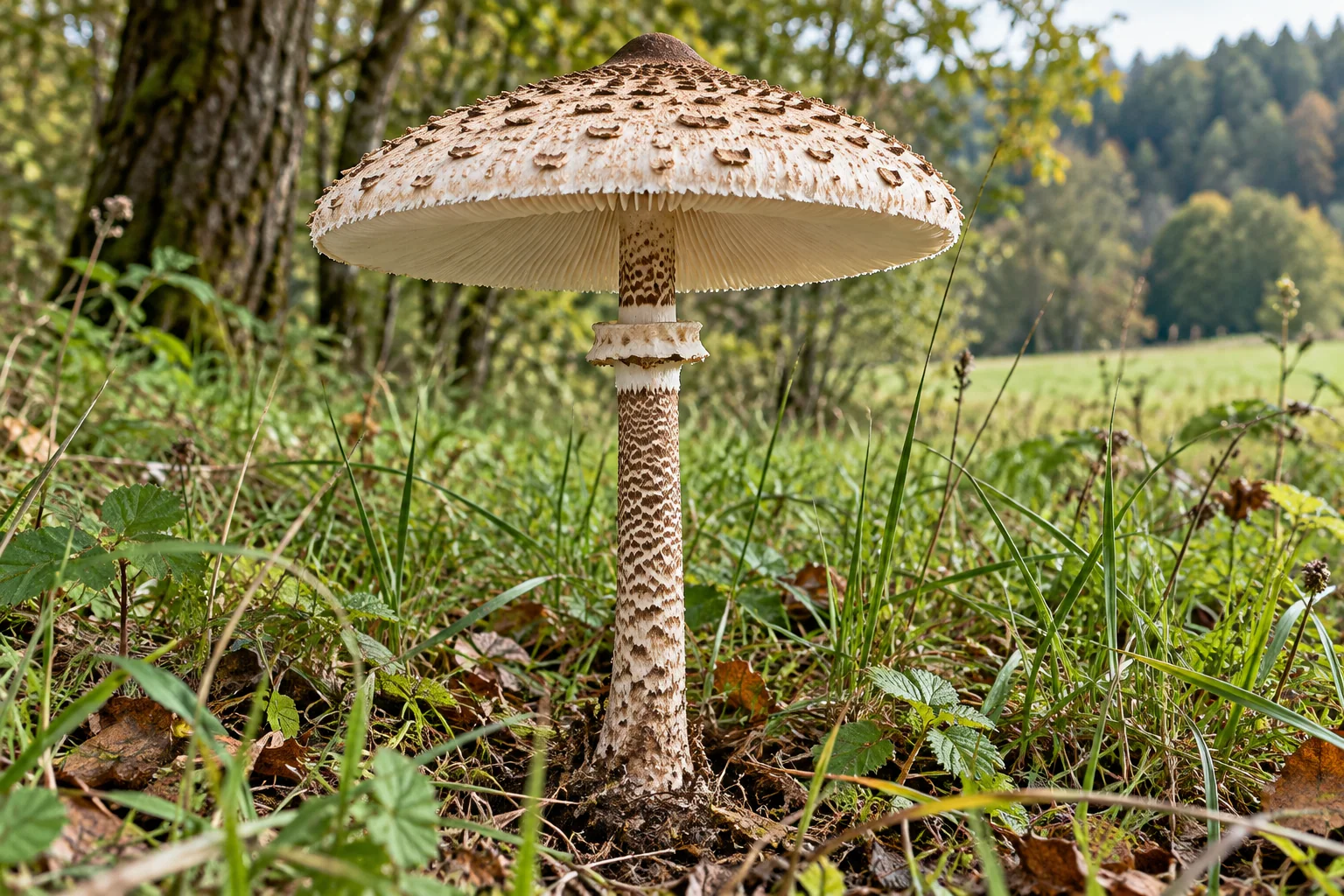
The parasol is a large terrestrial member of the Agaricaceae. Young caps are closed and egg-shaped; at maturity they open like an umbrella, with a central umbo and brown scales on a pale background. The gills are pale, crowded and free from the stem. Its tall slender stem has a brown zigzag pattern, and typical specimens carry a broad movable ring. It grows in clearings, grassland, woodland edges and other grassy places rich in organic matter. [8]
Unlike porcini and chanterelles, Macrolepiota procera is saprotrophic: it uses organic matter in the soil rather than forming the typical ectomycorrhizal partnership with a tree. It appears from spring to autumn depending on region and weather, often singly or in loose groups. It is edible; culinary traditions mainly use the cap, while the stem is more fibrous. [8]
Lookalikes are best compared by size and structure, not colour alone. Chlorophyllum brunneum can cause gastrointestinal upset; it is more robust, with a margined bulbous base and different stem traits. Chlorophyllum molybdites is a poisonous species found especially in some regions outside Europe: its gills become greenish and its spore print is green. Small Lepiota species are a separate group; some, such as Lepiota brunneoincarnata, contain amatoxins and are potentially fatal. They are much smaller, not ‘tiny parasols’. [8] [9] [10]
Nutrition, history and uses: what the evidence says
Fresh mushrooms contain a high proportion of water; drying changes their weight substantially and concentrates many constituents per 100 grams. Studies of Boletus edulis, Cantharellus cibarius and Macrolepiota procera measure protein, carbohydrates, fibre, minerals and other compounds, but results depend on species, soil, season, sampled part and preparation. Research on Macrolepiota procera has also examined how soil and proximity to roads relate to mineral composition, showing that the growing environment matters. A single study or site cannot provide a fixed profile for every specimen. [11] [12] [13]
These three fungi have established food names in several European languages and appear in regional culinary traditions. Their culinary history also involves seasonal gathering, preservation and drying. Cultural food use documents a relationship with food; it does not automatically establish medicinal properties. This article focuses on food data and culinary uses. [2] [5] [8]
Ecologically, porcini and chanterelles participate in ectomycorrhizae: fungi and tree roots exchange resources and form a biological network in soil. The parasol contributes differently by decomposing organic matter. The fruiting body that appears after rain and suitable conditions is only one visible phase of processes that continue underground through the year. [5] [13] [14]
Sources and further reading
- Université Claude Bernard Lyon 1 — Boletus edulis: caratteri, habitat e commestibilità
- COFORD — Forest Fungi in Ireland: schede ecologiche e identificative
- Université Claude Bernard Lyon 1 — Rubroboletus satanas: morfologia e tossicità
- NatureScot — Chanterelle: tassonomia, distribuzione e specie-complesse
- Olariaga et al. — Cantharellus in Europe revisited through a multigene phylogeny, Fungal Diversity (2017)
- Woodland Trust — Chanterelle: habitat, caratteri e specie simili
- République et canton de Genève — Cantharellus e Omphalotus illudens: differenze e tossicità
- Université de Rouen — Macrolepiota procera: descrizione, habitat e confusione con altre lepiote
- University of Florida IFAS Extension — Chlorophyllum molybdites, parasol velenoso e confronto morfologico
- Belgian Poison Centre — specie di Lepiota velenose, tra cui Lepiota brunneoincarnata
- Skrzypczak & Bernaś — Composizione e proprietà di Boletus edulis preparato per il consumo (2015)
- Review — Nutritional, nutraceutical and medicinal potential of Cantharellus cibarius (2024)
- Mleczek et al. — Suolo, traffico e composizione minerale di Macrolepiota procera, Chemosphere (2022)
- Treindl & Leuchtmann — Associazioni ectomicorriziche di Boletus edulis, Alpine Botany (2019)
- Université Claude Bernard Lyon 1 — Tylopilus felleus: pori rosati e sapore amaro